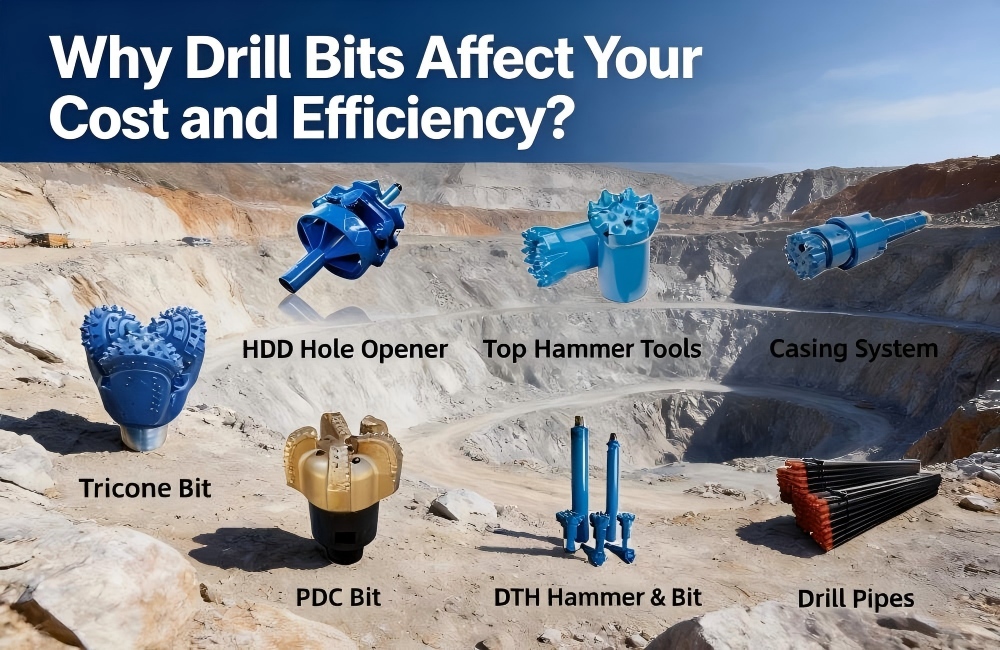
From a Manufacturer’s Perspective: Why Drill Bits Affect Your Cost and Efficiency?
We are a rock drilling tool manufacturer. Drill bits, rock, hammers – this is what we deal with every day. Whether you use DTH bits, a tricone drill bit, or other types, the principle is the same.
In this industry, there’s a common misconception: a drill bit is just a consumable. Cheap is what matters most.
But anyone who has actually calculated cost knows the truth – drill bits (including every kind, from button bits to the tricone drill bit) are one of the key factors that directly impact your drilling cost and efficiency.
Let us walk you through the numbers from a real manufacturing point of view.
1. Drill bits determine your penetration rate
Drilling efficiency starts with one thing: meters drilled per hour.
A well-designed drill bit – with quality carbide, proper gage retention, and a good face pattern – allows you to drill fast and consistently at recommended parameters. The same holds true for a tricone drill bit: good bearing seals and tooth geometry keep you moving. Time per meter is short and predictable.
A poor drill bit – one that wears fast, loses gage, or chips easily – forces you to slow down. Time per meter can easily double.
Same rig, same driller. Just change the drill bit, and your daily footage can be several times different.
2. Drill bits decide how often you have to trip out
The biggest hidden time-killer in drilling is frequent tripping out.
A high-quality drill bit lasts. It drills tens or even hundreds of meters without coming out of the hole. Effective drilling time is maximized. A premium tricone drill bit can deliver the same long life in rotary applications.
A cheap drill bit may fail – chip, lose gage, or break a wing – after just a few meters. For a tricone drill bit, failure might mean a stuck cone or broken journal. You have to trip out, change the drill bit, and go back in.
Every trip-out takes time:
Stop drilling
Pull rods
Remove old drill bit
Install new drill bit
Lower rods back into the hole
One trip can cost 15 minutes to half an hour. A couple of extra trips per day means one to two hours of lost production.
In rock drilling, fewer trips = more footage. That’s the real efficiency gain from good drill bits.
3. Drill bit quality affects hole quality – and everything after
A drill bit that wears unevenly or loses gage leads to:
Undersized or oversized holes
Irregular walls, cavings
Deviated holes
This applies to any type, including the tricone drill bit. Worn cones or uneven teeth create the same problems.
You may not notice these issues immediately while drilling. But they show up later – when you try to run casing, perform grouting, set anchors, or load blast holes. Casing gets stuck, grout volume goes up, anchors won’t fit.
A good drill bit doesn’t just drill fast – it sets the foundation for the rest of the project.
4. Drill bits also impact tool wear and energy cost
Drill rods and hammers: A drill bit with chipped teeth or worn gage causes uneven drilling resistance. The hammer operates erratically, and rods suffer abnormal cyclic stress. The result? Rod failures and damaged hammers. For a tricone drill bit, worn bearings or lost teeth can cause severe vibration that damages the entire drill string. A drill bit might cost a few hundred dollars. A rod or hammer repair can cost thousands.
Energy consumption: A dull drill bit requires higher impact pressure and more torque. Your compressor or hydraulic system works harder – fuel or electricity bills go up.
5. Our advice as a drilling tool manufacturer
If you are struggling with low penetration rates or high cost-per-meter, ask yourself a few simple questions:
Do I focus only on the drill bit price, while ignoring trip time and labor costs?
Do I know the actual life and average penetration rate of the drill bits I use on this specific ground? Have I tested a tricone drill bit side by side with others?
How many rod/hammer failures are actually caused by poor drill bit performance?
The best way to find the truth is not to listen to claims – run a field test. Use your current drill bit and one of our drill bits on the same rig, same rock, for a reasonable distance (e.g. 50 meters). If you use rotary drilling, include a tricone drill bit in the test. Record penetration rate, drill bit life, number of trips, and any tool issues. Let the data speak.
6. Why do we care about this?
We are not just a drill bit manufacturer – we have also used thousands of drill bits on real mine and construction sites, including countless tricone drill bits in rotary applications.
So we know this for a fact: a good drill bit saves you far more money than it costs.
We share these experiences because we believe that when you lower your cost-per-meter and finish your projects on time, we build a long-term partnership.
If you would like to discuss drill bit selection for your specific ground conditions – whether DTH bits or a tricone drill bit – or set up a side-by-side field test, feel free to contact us anytime.