Why do drill rods have a short service life? Four areas to investigate: material selection, operation, environment, and maintenance
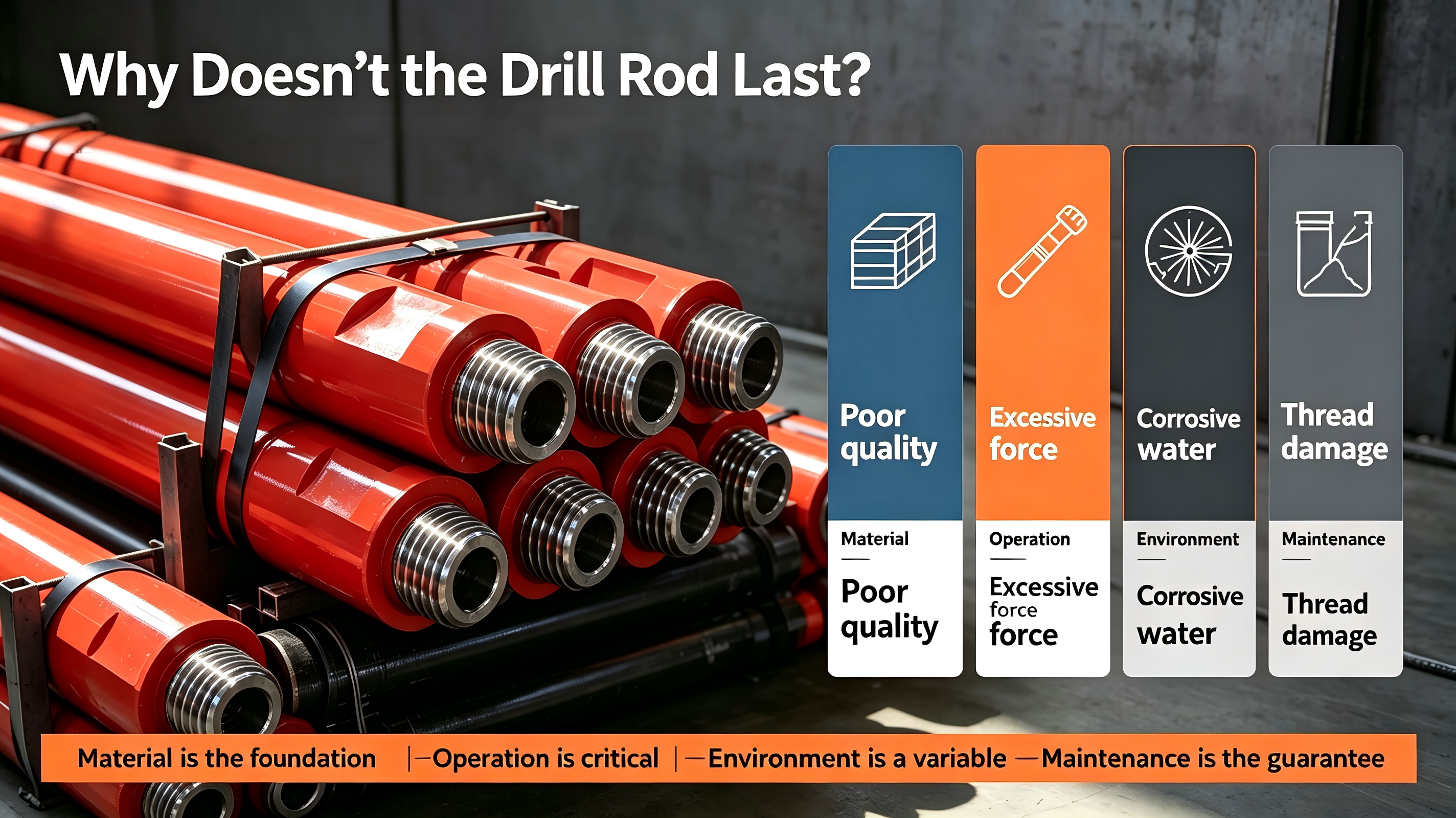
In rock drilling operations, the service life of a drill rod directly impacts drilling efficiency, downtime, and overall costs. Drill rods of the same specification can perform very differently depending on the job site, equipment, and operator habits. Some consistently achieve significant drilling depth, while others suffer from rod breakage, thread damage, or premature failure. These discrepancies usually stem not just from the rod itself, but from the interplay of four factors: material, operation, environment, and maintenance. Here, we analyze these four key aspects from the manufacturer's perspective.
I. Material quality is the foundation; internal purity determines fatigue resistance.
During operation, drill rods endure high-frequency impact, torsional, and bending loads, demanding high internal steel quality. If raw materials contain excessive inclusions or gas, or suffer from defects like segregation or air bubbles, these areas become stress concentration points. Under repeated impact, cracks easily initiate and propagate from within, eventually leading to breakage in the rod body or threaded sections.
Therefore, material selection should not be based on price alone; factors such as the steel source, smelting quality, and heat treatment process are crucial. If the material foundation is poor, service life will be limited regardless of how carefully the rod is used. Reputable manufacturers strictly inspect raw materials, providing the first line of defense for reliable performance.
Manufacturer's advice: When purchasing, proactively inquire about the steel grade, heat treatment method, and quality certification. Products with excessively low prices often harbor hidden defects rooted in the material itself.
II. Operational methods have a massive impact; overloading accelerates failure.
Blindly increasing feed force or impact frequency when encountering hard rock—or continuing to drill with an already bent rod—subjects the rod to stresses beyond its design limits. A bent rod generates alternating stress during rotation, while uneven force distribution accelerates wear at the threaded connections.
Unstable collaring, hole deviation, and mismatched feed and impact parameters also increase lateral loads. Many instances of premature breakage are not caused by a sudden drop in rod quality, but rather by prolonged operation under improper conditions. Adjusting parameters promptly based on changes in rock strata and replacing components immediately upon detecting anomalies are key to extending service life.
Manufacturer's Recommendation: Operators should understand the principles of parameter matching for different rock formations. If a drill rod exhibits significant bending or abnormal vibration, operations should be halted for inspection to avoid working with damaged equipment.
III. Corrosive environments cannot be ignored; acidic water weakens the rod's structural integrity.
Groundwater in some mines and tunnels is corrosive, containing substances such as chloride and sulfate ions. Prolonged exposure to these media causes gradual pitting or rusting on the rod's surface. Corrosion pits not only reduce the effective load-bearing cross-section but also serve as initiation points for cracks. The damage caused by corrosion is particularly pronounced in areas of stress concentration, such as the thread roots and the transition zones of the rod body.
Some drill rods may appear to have only minor surface rust while suffering from internal corrosion. Under impact loads, these compromised areas are prone to premature failure.
Manufacturer's Recommendation: In corrosive operating conditions, select drill rods with anti-corrosion surface treatments and minimize the time rods spend in humid storage. Clean and dry the rods promptly after use, and periodically reapply anti-rust grease.
IV. Inadequate maintenance leads to early damage at connection points.
Drill rod failure often originates at the threads and connection points. Continued use of drill bits with threads worn beyond acceptable limits increases clearance gaps, reduces impact energy transfer efficiency, and generates additional friction and bending stress on the threaded sections. Connections that are either too tight or too loose can cause disassembly difficulties, thread damage, or fatigue from repeated impacts.
Furthermore, failure to promptly clear rock dust from threads after drilling operations leads to abrasive wear during the next connection; failure to periodically reapply anti-rust grease makes threads susceptible to rust in humid environments. The accumulation of these minor daily issues can lead to the premature scrapping of the drill rod.
Manufacturer's Recommendation: Maintain usage and inspection records for drill rods and periodically measure thread wear. Clean the threads and apply specialized anti-rust grease before and after each shift. While this may seem like extra work, it actually reduces the costs associated with frequent drill rod replacement.
Conclusion
The service life of a drill rod is not determined by a single factor. Materials form the foundation, operation is the key, the working environment is a variable, and maintenance ensures reliability. For contractors, establishing a system for the inspection, replacement, and maintenance of drill rods is more effective at reducing overall costs than simply prioritizing low procurement prices.
As a manufacturer of rock drilling tools, we recommend that users select the right products based on actual working conditions and adhere to proper usage and maintenance practices. Only when every aspect is managed correctly can drill rods deliver optimal performance and ensure consistent drilling efficiency.
We specialize in manufacturing various types of rock drilling rods, utilizing proven material selection, heat treatment, and machining processes to provide products tailored to specific rock formations and operating conditions. If you have any questions regarding drill rod selection, usage, or maintenance, please feel free to contact us:
Emily Peng (Product Manager)
E-mail: [email protected]
Tel: +86 191 7333 7543