High Drilling Costs Per Meter? A Refined Cost Control Approach: Controlling Losses, Ensuring Quality, and Improving Profits
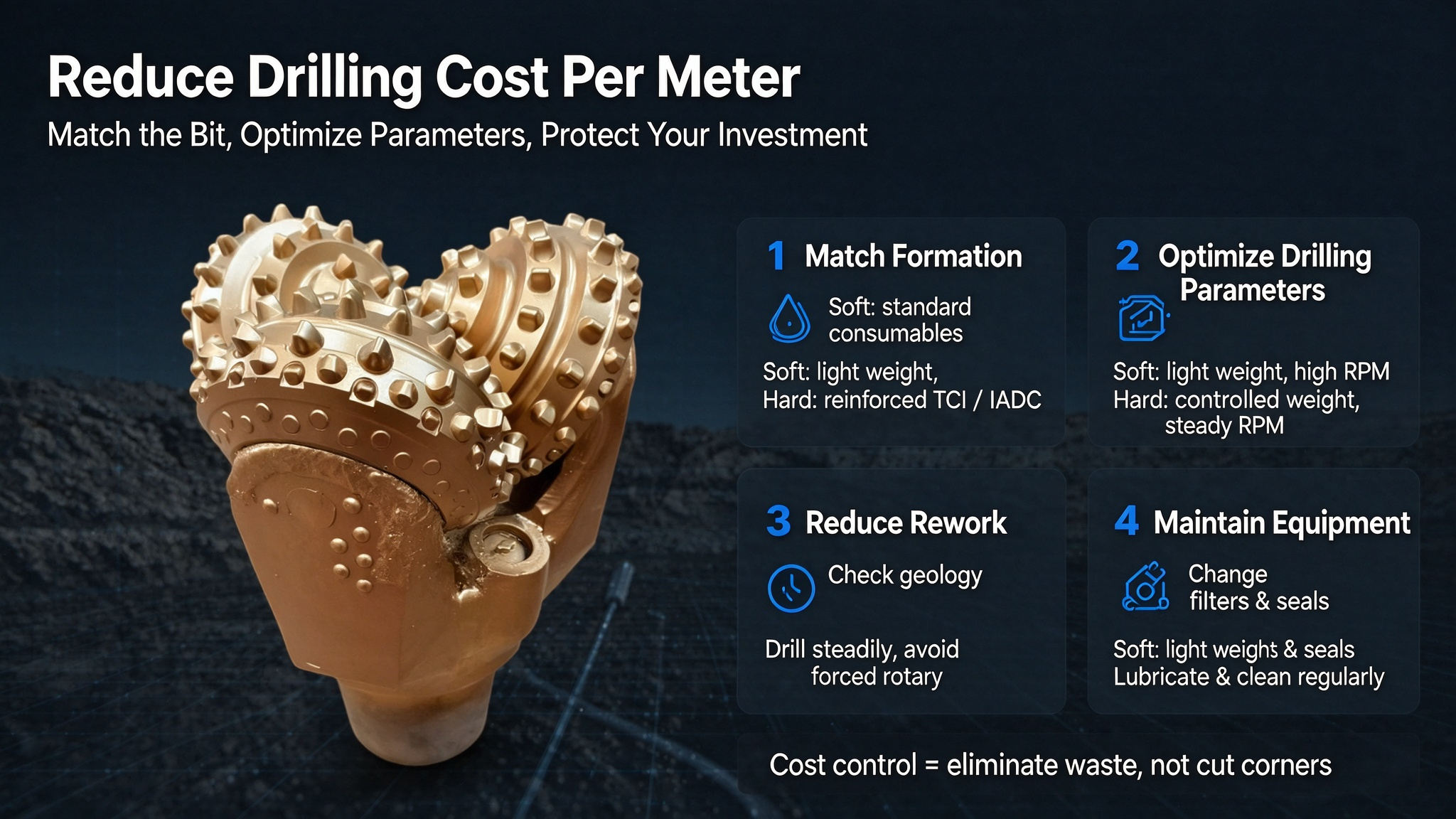
The drilling industry is experiencing increasingly transparent pricing and intensifying competition. Many projects appear to have substantial workloads, but after settlement, profits are far lower than expected. Many managers initially attribute this to low bid prices, but a review of the entire project reveals that the erosion of profits is often not due to the bid price, but rather the persistently high overall cost per meter of drilling.
Unplanned consumption of drilling consumables, non-standard on-site operations, ineffective rig idling, and repeated rework due to failed boreholes—these seemingly minor issues scattered throughout the construction site accumulate and steadily erode project profitability.
Many construction teams easily fall into the same misconception when it comes to cost reduction: believing that cost reduction equals cutting back on investment, reducing parts replacements, reducing necessary consumables, and simplifying construction processes.
However, frontline drilling experience has long proven that relying on extensive cost-saving measures like "saving on parts and reducing procedures" is merely a short-term illusion. Continuing to operate faulty parts can easily lead to tooth breakage, seal failure, and in-hole accidents. The resulting rework, equipment overhauls, project delays, and acceptance rectification costs can significantly increase overall costs.
Truly sustainable cost reduction hinges on the principle of "not compromising hole quality, not exceeding project acceptance standards, eliminating ineffective waste through meticulous management, and releasing previously wasted profit margins."
I. Site-Specific Tool Selection: Choosing the Right Drilling Tools is the Starting Point for Consumable Cost Control
Mismatch between drilling tools and formation conditions is the primary source of waste in on-site consumables.
Blindly using high-specification tricone or PDC drill bits designed for hard rock in soft soil or loose formations renders the high-performance carbide teeth useless, resulting in unnecessary consumption of high-end consumables. Conversely, using low-specification drilling tools with insufficient load-bearing capacity in highly abrasive and hard rock formations leads to rapid wear and breakage of the drill bit teeth, frequent tripping and bit replacements, significantly reducing drilling speed and doubling consumable costs.
A scientific approach involves planning drill bit configuration according to geological stratification: economical drill bits are used in soft, conventional formations to control initial investment; for medium-hard, highly abrasive formations, corresponding IADC-level roller cone bits or reinforced PDC bits are used to ensure drilling efficiency and service life.
As a drill bit manufacturer, we also assist customers in matching suitable drill bit models and tooth profiles based on the geological data provided, avoiding blind procurement and preventing waste from mismatches.
Simultaneously, we implement tiered management of existing drill bits, avoiding indiscriminate scrapping.
Slightly worn drill bits and sealing components with intact teeth do not need to be scrapped directly; they can be reassigned to shallow, low-load soft formations for continued use, fully utilizing their remaining service life. However, drill bits exhibiting severe tooth breakage, shell cracking, or seal failure must be replaced immediately. Drilling with faulty components is strictly prohibited to avoid risks such as stuck drill bits and borehole collapse.
II. Standardized Drilling Operations: Reducing Impact Loss and Lowering Energy Costs
Operators' work habits directly determine the wear rate of the drilling rig, drill rod, and drill bit, as well as fuel and electricity consumption.
Many novice operators habitually use high-pressure, high-speed idling, and frequent start-stop operations. While this may seem to result in rapid short-term progress, the continuous impact load accelerates the wear of drill bit teeth, bearings, drill rod threads, and the power head. When the drilling rig is idling without any progress, fuel and electricity are purely wasted. Over a project, the accumulated energy consumption and parts wear costs are considerable.
Experienced drilling teams always adjust parameters dynamically according to the formation conditions: In soft soil layers, use light drill pressure and high drilling speed for rapid drilling; in hard rock formations, reduce the drilling speed and match a reasonable drill pressure for steady, uniform drilling, reducing the instantaneous impact on the drill bit.
After each day's work, promptly stop the machine, clean the drill bit and drill rod surfaces of mud and rock cuttings, and perform simple cleaning to reduce additional wear from mud and sand abrasion. A stable and standardized operating procedure can extend the service life of the entire drilling tool set and stabilize the average mechanical drilling speed.
III. Prioritize Rework: The Most Cost-Effective Way to Reduce Costs
Secondary drilling due to problems such as hole collapse, deviation, and excessive sediment is a key factor in the loss of cost control in many projects. Rework not only doubles the consumption of drill bits, mud, and fuel, but also delays the project and incurs additional labor and equipment operating costs.
To avoid rework, the key is proactive management: In the early stages of construction, combine geological data to predict risks, reasonably set the casing embedment depth, and adjust mud properties in advance; during drilling, advance at a constant speed, avoiding forced pressure drilling; when encountering complex strata such as karst caves, quicksand, and fractured zones, adjust drilling techniques and parameters promptly to strive for a successful hole on the first attempt. A successful first-time delivery is far more cost-effective and worry-free than subsequent rectification.
IV. Routine Equipment Maintenance: Establishing a Long-Term Cost Protection Line
Cost reduction is not a one-time action; long-term stable benefits rely on a continuous equipment maintenance system.
Regularly change the oil, filters, and seals according to working hours; apply grease to drill pipe threads and bearings on time; and promptly clean accumulated rock powder and mud from inside the equipment. Properly maintained drilling rigs and drill string assemblies have a lower probability of failure, more stable drilling performance, and controllable wear of drill bits and drill pipes.
Conversely, neglecting daily maintenance allows equipment hazards to accumulate, easily leading to sudden shutdowns, bearing seizures, premature drill bit failures, and necessitating emergency repairs and urgent replacements, often resulting in high costs, tight deadlines, and additional passive expenses for the project.
In conclusion, cost reduction in drilling engineering is fundamentally unrelated to cutting corners.
It is a systematic management approach that permeates selection, on-site operation, consumable management, equipment maintenance, and risk assessment: rationally selecting drill string components, utilizing existing spare parts, standardizing drilling parameters, strictly controlling rework probability, and adhering to regular maintenance—eliminating all ineffective consumption while maintaining the bottom line of construction quality.
As a source manufacturer of drilling tools, we not only supply customers with tricone bits, PDC bits, and down-the-hole drills, but also offer practical advice on drill bit selection, usage, and maintenance, tailored to different formations and project conditions. Together, we aim to stabilize drilling footage, control cost per meter, and safeguard project profits.
If you have formation data or pain points regarding drill bit usage, please feel free to contact us.
Tel: +86 193 1332 3238