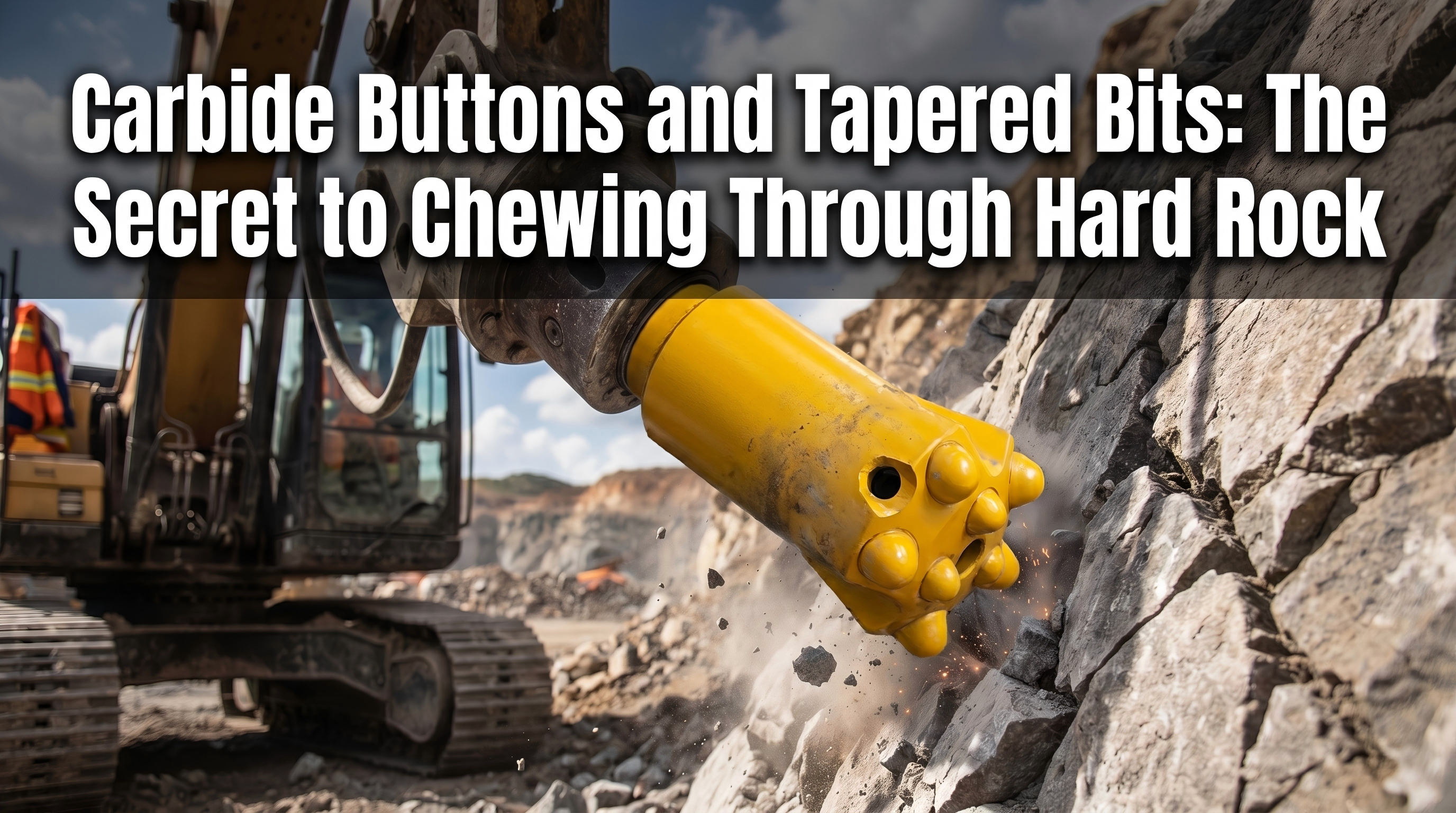
 Carbide Buttons and Tapered Bits: The Secret to Chewing Through Hard Rock
At the working face of a mine tunnel, a rock drill drives a tapered bit equipped with carbide buttons rapidly into solid granite. The hemispherical protrusions on the bit's face are the cemented carbide buttons. How do these tiny buttons—measuring only a few millimeters in diameter—manage to crush rock with a compressive strength exceeding 200 MPa? The answer lies in the material composition, mechanics, and structural design.
I. Rock-Breaking Mechanism: Synergistic Point-Contact Crushing and Percussive-Rotary Action
Tapered bits with carbide buttons operate on the principle of percussive-rotary rock breaking. Impact energy generated by the rock drill travels through the drill rod to the bit body, where it is distributed to each carbide button. When the hemispherical tip of a button contacts the rock, the contact area is minuscule—typically just a few square millimeters. The resulting instantaneous contact stress easily surpasses the rock's compressive strength limit, causing brittle fracture. The bit then rotates slightly to chip away the fractured rock surface; this cycle repeats, allowing the borehole to advance deeper into the rock formation.
This sequence of "point-contact crushing, crack propagation, and chip ejection" distinguishes carbide-button tapered bits from cutting-type drilling tools. Because the buttons are omnidirectional, they maintain consistent rock-breaking performance regardless of the rotation angle—a key advantage over chisel-type or cross-type tapered bits.
II. The Material Secret: Balancing Tungsten Carbide and Cobalt
The ability of carbide buttons to withstand high-frequency, high-intensity impacts stems fundamentally from their material composition. These buttons are manufactured using a powder metallurgy sintering process that combines hard tungsten carbide particles with cobalt, which acts as a binder. Tungsten carbide possesses a micro-hardness approaching that of diamond, providing exceptional wear resistance, while cobalt imparts the necessary impact toughness. The specific ratio of these two components—one hard and one tough—directly determines the button's operational performance. For different rock formations, Tapered Button Bits require the selection of specific grades of cemented carbide buttons. Extremely hard rock formations call for low-cobalt, fine-grained grades to enhance wear resistance and crush resistance. Conversely, for rock formations characterized by extensive fracturing and unstable impact loads, high-cobalt grades are selected to prevent the buttons from chipping or breaking under frequent impacts. Precise control of tungsten carbide grain size and the uniformity of cobalt phase distribution are key indicators of cemented carbide button quality.
III. Button Profile Design: Application Logic for Hemispherical, Conical-Ballistic, and Parabolic Shapes
The geometric shape of the button tip directly influences rock-breaking efficiency and service life. Hemispherical buttons offer the highest strength and impact resistance; lacking sharp edges and minimizing stress concentration, they are the preferred choice for tapered button bits used in extremely hard rock. Conical-ballistic buttons modify the hemispherical design by reducing the tip's radius of curvature, thereby enhancing rock penetration capability and drilling efficiency in hard-to-medium-hard rock; they are currently among the most widely used button profiles. Parabolic buttons feature the sharpest tips and greatest penetration capability, making them suitable for rapid drilling in soft-to-medium-hard rock, though their impact resistance is relatively lower. Designers must match the button profile and protrusion height to the target rock's hardness, abrasiveness, and fracture characteristics to strike an optimal balance between drilling efficiency and bit longevity.
IV. Button Layout Patterns: Scientific Arrangement from Center to Periphery
The distribution of buttons on the bit face is not arbitrary but follows a strict layout logic. Center buttons, located at the very center of the face, bear the highest impact loads; with zero linear velocity, they face the most severe wear conditions and typically utilize larger-diameter cemented carbide buttons. Gauge buttons (or edge buttons) are distributed along the bit's outermost periphery; experiencing the highest linear velocity, they are responsible for trimming the borehole wall and maintaining the hole diameter, representing a critical and challenging aspect of tapered button bit design.
Button layout density is equally crucial. If buttons are spaced too closely, the impact energy distributed to each individual button is insufficient, resulting in reduced drilling efficiency. If the button layout is too sparse, individual buttons bear excessive loads, increasing the risk of breakage or detachment. Modern designs for tapered button bits rely heavily on computer numerical simulation to scientifically balance drilling efficiency and bit service life, replacing traditional empirical trial-and-error methods with precise calculations.
V. Manufacturing Process: Brazing Quality and Taper Precision
The connection between the cemented carbide buttons and the bit body is achieved through brazing. High-frequency induction brazing or flame brazing melts copper- or silver-based filler metal, which uniformly fills the gaps around the buttons to form a strong metallurgical bond. Strict control over brazing temperature, heating rate, and holding time is crucial to preventing button detachment during operation. Before leaving the factory, high-quality tapered button bits undergo rigorous visual inspections and destructive sampling tests to ensure consistent and reliable brazing quality.
The taper connection serves as the interface between the bit and the drill rod. An interference fit is formed between the tapered socket at the rear of the bit body and the tapered end of the rod, allowing for quick assembly/disassembly and direct energy transfer. Standard taper angles—commonly 7°, 11°, or 12°—must precisely match those of the drill rod; a fit that is too loose risks bit loss, while one that is too tight may cause the socket to split. High-precision machining of the tapered socket and surface hardening treatments are vital steps in ensuring the reliability of the connection.
VI. Selection and Application: Matching Strategies for Different Rock Formations
Tapered button bits are widely used in sectors such as mining, tunneling, rock bolting, hydropower engineering, and quarrying. For extremely hard rock formations like granite and basalt, hemispherical buttons made of low-cobalt, fine-grained cemented carbide are preferred to prioritize wear resistance and compressive strength. In hard to medium-hard formations like limestone and sandstone, ballistic (conical-spherical) buttons offer an optimal balance between efficiency and service life. For highly fractured rock formations—regardless of hardness—tougher, high-cobalt carbide grades and hemispherical buttons should be selected, with increased button density to better distribute impact loads. For soft rock and loose strata, parabolic-shaped carbide inserts can be selected; reducing the insert density increases the space for cuttings evacuation, thereby enabling rapid drilling.
Behind the journey from a tiny cemented carbide spherical insert to the drilling path it carves into hard rock lies a deep integration of materials science, impact mechanics, and precision manufacturing processes. Only by understanding the rock-breaking principles of tapered spherical-insert bits—and mastering the scientific methods for their selection and operation—can this small bit truly deliver peak drilling performance in hard rock.
If you are looking to source tapered drill bits, please feel free to contact us. As a direct manufacturer, we offer customization for various button-type tapered drill bits—handling everything from carbide insert selection to taper matching—to provide you with cost-effective, one-stop rock drilling tool solutions.