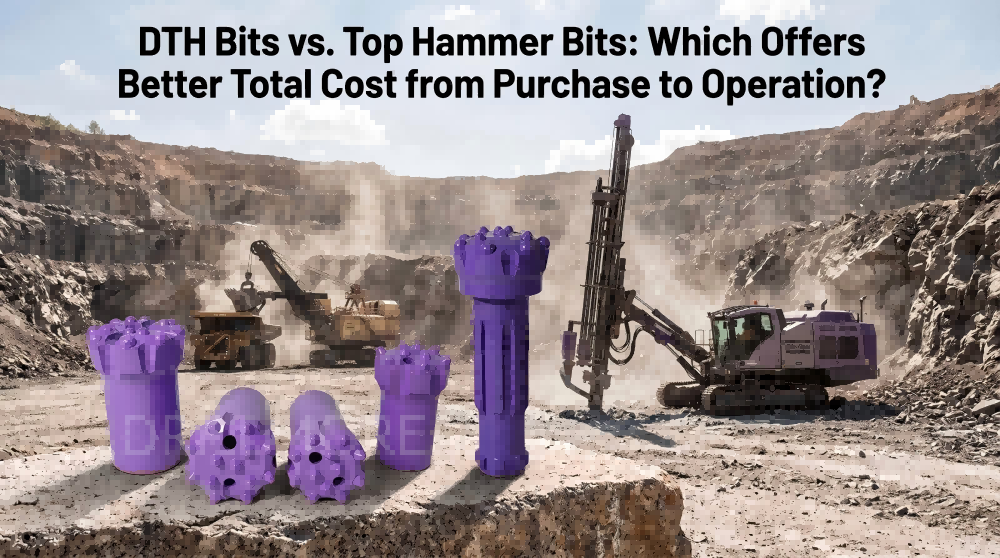
 DTH Bits vs. Top Hammer Bits: Which Offers Better Total Cost from Purchase to Operation?
In the drilling industry, choosing the wrong bit can consistently erode project profits. As a specialized manufacturer producing both DTH (Down-The-Hole) and top hammer bits, we frequently hear the question: "How do I choose between DTH and top hammer bits?" Today, as the direct manufacturer, we break down the total costs—covering procurement, operation, maintenance, and service life—to give you a clear comparison. By reading this technical analysis, you will understand which bit suits specific working conditions and how the factory-direct model helps minimize your cost per meter.
I. Fundamental Difference: Where Energy Is Released
The core difference between DTH and top hammer bits lies in where the impact energy is generated. DTH bits operate with an in-the-hole hammer located at the bottom of the borehole; the piston strikes the bit directly, delivering energy straight to the rock while the exhaust airflow cools the bit. In contrast, top hammer systems rely on a surface-mounted hydraulic rock drill, with impact force transmitted down the drill string to the bottom of the hole.
This mechanism dictates performance: DTH bits are far more efficient in deep holes and hard rock, whereas top hammer bits are more economical for shallow holes and soft rock. As a pragmatic manufacturer producing both types in volume, we must emphasize to every customer: there is no "universal" bit—only the bit that best fits the specific working conditions.
II. Procurement Costs: Lower Entry Cost for Top Hammer Bits; Higher system Investment for DTH
Looking solely at the purchase price of the bit itself, top hammer bits of the same specification are indeed cheaper. However, as an experienced manufacturer, we must point out that procurement is only the first step. DTH bits require a high-capacity, high-pressure air compressor, an in-the-hole hammer, and specialized drill rods; consequently, the initial investment for the entire DTH drilling system is often 30% to 50% higher than that of a top hammer system. However, after calculating total lifecycle costs, many long-term clients eventually switch their primary equipment to DTH (Down-The-Hole) drilling tools. While top-hammer bits have a lower initial purchase price, DTH tools offer a massive advantage in operating costs under the right conditions. For users prioritizing cost-effectiveness, our factory offers a direct-sales package combining DTH bits and hammers, significantly lowering the barrier to entry for the system.
III. Operating Costs: Hole Depth is the True Deciding Factor
The secret to operating costs lies in the hole depth figures. Based on comprehensive field data from thousands of sites, our factory has reached a clear conclusion:
Depth < 15 meters: Top-hammer bits offer superior overall operating costs. Within this range, top-hammer bits deliver fast drilling speeds, minimal energy loss, and low fuel or electricity consumption. For shallow-hole operations, even though we manufacture DTH bits ourselves, we would still recommend top-hammer bits first.
Depth > 25 meters: DTH bits become more cost-effective. Beyond 25 meters, top-hammer systems suffer from sharp energy loss at drill rod joints, drastically reduced drilling speeds, and accelerated wear and heat buildup on rod threads. In contrast, the DTH hammer operates at the bottom of the hole, reducing the time required to drill each meter by 30% to 50% compared to top-hammer systems. Real-world data from our direct-sales clients shows that when drilling 115mm diameter, 50-meter-deep holes in granite, the DTH solution results in total fuel consumption and drill rod wear that are only 60% of those associated with top-hammer systems, leading to a significantly lower overall cost per meter.
IV. Maintenance and Lifespan: A Vast Difference in Drill Rod Costs
This is the most easily overlooked hidden cost. Top-hammer drill rods are subjected to repeated tensile and compressive impacts, making the threaded sections highly susceptible to fatigue, wear, or breakage. During continuous deep-hole operations, the cost of drill rod consumption often exceeds the price of the drill bit itself. In contrast, with DTH (Down-The-Hole) bits, the impact action occurs at the bottom of the hole; the drill rod merely provides feed force and rotational torque, remaining largely free from impact loads. Consequently, their service life is three to five times that of top-hammer drill rods.
As a manufacturer that prioritizes data-driven precision, we offer a simple rule of thumb: if your annual drilling footage exceeds 10,000 meters, DTH bits should be your first choice. The savings on drill rod procurement alone are often enough to purchase multiple sets of brand-new DTH bits directly from our factory. Furthermore, the optimized carbide buttons and splines of our DTH bits—combined with their superior performance in abrasive, hard rock—further widen the gap in total lifecycle costs.
V. Factory-Direct Supply: Two Bit Types, One Source, Unbiased Selection
While many market suppliers push only one type of bit, we are one of the few manufacturers in the industry operating fully automated production lines for both DTH and top-hammer bits; we have no vested interest in favoring one over the other. By purchasing directly from us, you not only secure factory-direct pricing but also receive truly objective selection advice—since we manufacture both types ourselves.
Simply provide us with three parameters: hole depth, rock type, and hole diameter. Our engineering team—drawing on direct experience from our R&D department—will immediately calculate the comprehensive cost-per-meter for both DTH and top-hammer options and recommend the most cost-effective choice. Whether you need DTH bits for deep-hole drilling in hard rock or high-efficiency top-hammer bits for shallow-hole drilling in soft rock, we serve as your primary supplier, providing all necessary drill rods, impactors, and customization services.
VI. Conclusion: Calculate the Full-Cycle Cost Before Choosing Between DTH and Top-Hammer Bits
When considering everything from procurement and operation to drill rod consumption and impactor maintenance, top-hammer bits offer better financial performance in shallow holes and soft rock, whereas DTH bits provide an unrivaled cost advantage in deep holes and hard rock. As a manufacturer committed to our customers' long-term success, our greatest value lies not in selling you the most expensive bit, but in helping you select the right tool to optimize your drilling cost per meter.
Contact our drill bit manufacturing team today to receive a tailored selection plan for DTH or top-hammer drill bits, along with a cost-per-meter analysis report.